Sleep comfort · Pillow fill guide
Choosing a Natural Pillow: Latex, Wool, and Kapok Compared
The right pillow is less about a fashionable label and more about how it feels beneath your head at 2 a.m. Latex, wool, and kapok each offer a different balance of support, softness, airflow, and adjustability. Understanding those differences can help you find a natural pillow that suits your sleep position and comfort preferences.
A pillow has a quiet but important job: it helps support your head and neck while your body settles into sleep. If the pillow is too high, too low, or simply not to your liking, you may spend the night shifting and rearranging it. The filling affects that experience—how quickly the pillow responds to movement, whether it holds its shape, how easily you can change its loft, and what care it needs.
For people comparing natural pillows, three popular fills are latex, wool, and kapok. Each comes with a distinct feel. Latex tends to be springy and resilient; wool offers a softer, compressible kind of support; kapok is light and airy, with a down-like softness. The names alone do not tell the whole story, though. Latex may be solid or shredded, wool can come as loose puffs or layers, and kapok pillows may allow fill to be added or removed.
This guide breaks down the practical differences, explains why sleeping position matters, and offers a simple way to narrow the field. There is no universally best pillow fill. The useful question is which one matches the way you sleep—and whether its feel and upkeep are right for your everyday life.
Start with support, not the material label
People often begin a pillow search with a material preference: perhaps they want plant- or animal-derived fibres, a more breathable surface, or fewer synthetic components. Those are reasonable considerations, but comfort still depends on the relationship between the pillow and your body.
A pillow’s loft is its height when supporting your head. Its firmness describes how much resistance it gives when compressed. Neither measure works in isolation. Your shoulder width, mattress feel, body shape, and habitual sleep position can all affect how much height feels comfortable. A side sleeper, for example, usually needs enough loft to fill the space between the shoulder and head. Someone sleeping on their back may prefer a lower profile that supports the natural curve of the neck without pushing the chin towards the chest.
Even the best-designed pillow can feel wrong if its shape does not suit your habits. If you change positions frequently, you may want a fill that can be shifted or reshaped. If you prefer a pillow that stays put rather than being scrunched during the night, a more shape-retaining construction may be appealing.
- Choose by feel: consider whether you prefer springy, softly compressible, or light and lofty support.
- Consider your position: sleeping on your side, back, or stomach can change the amount of loft that feels comfortable.
- Check adjustability: removable fill can help you fine-tune a pillow, but it may also require occasional reshaping.
- Read the care label: the cover may be washable even when the filling is not.
Think of these as practical starting points rather than strict rules. Comfort is personal, and a pillow’s advertised firmness does not always predict precisely how it will feel once you lie down.
Latex: resilient support with a springy feel
Latex pillows are made with either a solid core or pieces of shredded latex. Both are known for a responsive feel: when pressure is released, the material tends to spring back rather than staying compressed like a soft, loosely packed filling. For someone who wants their pillow to keep a more consistent shape through the night, that resilience may be a welcome feature.
Solid latex
A solid latex pillow has a single moulded core, often with perforations or air channels. Its shape is relatively consistent, which can make it a straightforward choice for people who dislike fluffing or rearranging their pillow. The core is not generally adjusted by taking out handfuls of fill, so the height and shape are less changeable than in a loose-fill design.
Some sleepers like the combination of gentle give and steady support. Others may find a solid pillow too structured, particularly if they prefer to fold, bunch, or scrunch their bedding into a custom shape. It is worth checking the pillow’s dimensions and profile as well as its stated feel: a supportive material can still be too high or too low for an individual.
Shredded latex
Shredded latex has a more malleable feel than a single core. The pieces can shift within the pillow, allowing some movement and contouring around the head. Depending on the design, the filling may be removable or otherwise adjustable. Check the specific construction rather than assuming all shredded latex pillows can be altered; some are not intended to be opened.
In general, latex is a better match for people who like a resilient, buoyant sensation than for those seeking a feather-light pillow. Its springiness may help it recover its shape after pressure, while the pieces in a shredded version can give it a more scrunchable quality. How airy or warm it feels will depend on the construction, cover, room temperature, and the sleeper.
What to know about care
Many latex pillows require spot cleaning rather than a full wash. Covers may have separate care instructions, and some can be removed for laundering. Latex can be sensitive to direct sunlight and heat, so follow the maker’s instructions and avoid improvising with a hot dryer. A washable pillow protector can help keep the pillow cleaner between washes.
For people who want a shape-retaining natural pillow and do not mind limited washability, latex can be a strong option. If you need a pillow that can go through frequent full washes, or you want to make large changes to its height, compare the care and construction details carefully before choosing.
Wool: soft, compressible, and naturally distinctive
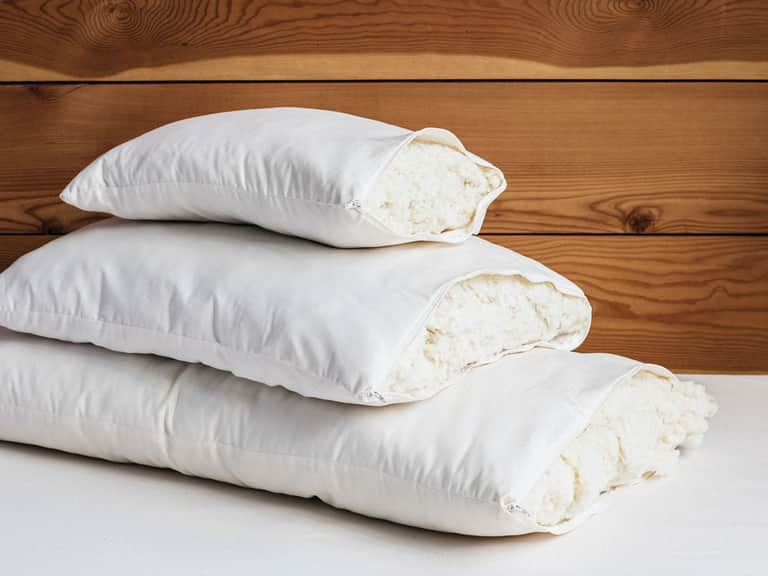
Wool pillows range from layered batting to small wool puffs, sometimes called wool bolus. Their feel is not identical across styles. A layered pillow may have a more even, structured profile, while a pillow filled with puffs may feel softer and more compressible. Some designs let you remove or add fill; others are built as a fixed form.
Wool has a different character from latex. Rather than a pronounced spring-back, it generally offers a softer, more yielding support. Wool fibres can manage moisture and help regulate warmth, but no material can guarantee that every sleeper will feel cool. Room conditions, bedding layers, personal temperature preferences, and the pillow’s construction all play a part.
Adjustable wool pillows can be useful if you want to customise loft. A zippered case may allow you to take out some of the wool or redistribute it, so the pillow feels less full or sits more comfortably beneath your head. That flexibility comes with a small trade-off: loose fill may need fluffing or reshaping from time to time, and the process of adjusting it can be more hands-on than using a fixed core.
Some wool pillows are sold as down alternatives. That describes a comparison in softness or form, not a promise that the materials feel identical. Wool puffs may have more substance and hold a shape differently from down. If you are switching from a traditional feather or down pillow, expect a different sensation and allow yourself time to decide what works.
Care considerations for wool
Care varies significantly by design. A removable cover may be machine washable, while the wool fill itself may be spot-clean only. For some pillows, the fill must be removed before washing the case; for others, the pillow as a whole is not meant to be washed. Read the care information before purchasing, especially if regular laundering is important in your household.
Wool is a natural animal fibre, so people with wool sensitivities or concerns about animal-derived materials may prefer another fill. Those considering wool for its sourcing credentials can look for clear information about fibre origin and relevant certifications, while remembering that certification standards apply to particular materials and processes rather than automatically describing every aspect of a finished pillow.
A wool pillow may suit someone who wants soft, compressible support, appreciates a natural fibre, and is comfortable with a little maintenance. It is less likely to please a sleeper who wants a pillow that feels very light, has a fixed contour, or can be tossed into the washing machine in its entirety.
Kapok: light loft and a soft, malleable feel
Kapok is a silky plant fibre from the seed pods of the kapok tree. In pillows, it is often used as a down alternative. Its appeal is partly its lightness: a kapok pillow can feel airy and soft rather than dense or springy. Depending on the fill quantity and construction, it may be fluffed and shaped to create a more personalised sleeping surface.
Adjustable kapok pillows can offer a particularly simple route to changing loft. If the pillow has an inner compartment or zippered case, you may be able to remove some filling to make it lower, or add it back to create a fuller feel. This can be helpful for sleepers whose preferred height is hard to find off the shelf, or for those still learning what support feels comfortable.
Kapok’s softness does not mean that it will suit everyone. A very light, malleable filling may need more reshaping than a solid latex core. Some sleepers enjoy that soft, scrunchable quality; others would rather have a pillow that holds a more defined shape. The density and amount of fill are important, so check whether the pillow is adjustable and how much material it contains.
As with wool, care instructions depend on the design. The outer case may be washable, while the filling itself may need spot cleaning or gentle airing. Avoid assuming that a natural fibre pillow can be washed like ordinary cotton laundry. Moisture, high heat, or rough handling can affect the fill, so follow the manufacturer’s directions.
Kapok may be worth considering if your priority is a lightweight pillow with a soft, shapeable feel and a plant-based fill. It may be less suitable if you prefer a dense, firmly supportive surface or do not want to fluff and adjust your pillow periodically.
Latex, wool, and kapok at a glance
| Fill | Typical feel | Adjustability | Care points | May appeal to sleepers who… |
|---|---|---|---|---|
| Solid latex | Resilient, springy, and relatively consistent | Usually limited; the core keeps its set shape | Often spot-clean only; protect from excess heat and direct sun as directed | Want a pillow that retains its general form and gives responsive support |
| Shredded latex | Springy but more malleable than a solid core | Varies; confirm whether fill can be removed | Fill may need spot cleaning; covers may have separate washing instructions | Like a resilient fill with a little more movement or scrunchability |
| Wool | Soft, compressible, and shapeable | Can be adjustable in designs with removable puffs or layers | Fill may not be washable; covers are often cared for separately | Prefer natural fibre support with a softer, less springy feel |
| Kapok | Light, airy, and often down-like in softness | Often adjustable when the construction has removable fill | Follow instructions carefully; the fill may need spot cleaning or airing | Want a lightweight, malleable pillow that can be fluffed or shaped |
These are broad comparisons, not guarantees. Construction, fill amount, cover fabric, and individual preference all influence how a pillow feels.
How sleeping position can guide your choice
Sleep position offers a useful starting point, but it is not a precise formula. A pillow should feel comfortable and help your head rest in a natural, supported position. If a pillow makes your neck feel pushed upwards or droop downwards, its height or shape may not be right for you.
Side sleepers
Side sleeping usually leaves a gap between the head and mattress created by the shoulder. A pillow with enough loft to bridge that gap may feel more comfortable than a very low, easily compressed option. Shredded latex can offer a mix of resilience and movement; an adjustable wool or kapok pillow may let you tune the height. The best choice depends on how much the fill compresses beneath your head and how broad your shoulders are.
Back sleepers
Back sleepers often look for a moderate or lower profile that supports the head without tilting it too far forward. A resilient pillow may suit someone who wants the support to remain steady, while an adjustable fill can help if you are uncertain about the right loft. If you already have neck discomfort, pillow choice is only one possible factor; persistent pain deserves advice from a qualified health professional.
Stomach sleepers
Stomach sleeping can place the neck in a rotated position, so some people prefer a very low, soft pillow or no head pillow at all. A lofty or densely filled pillow may feel too high. If you sleep on your stomach for part of the night, a pillow with removable fill can make experimentation easier, but comfort and individual needs should guide the decision.
Combination sleepers
If you move between positions, flexibility may matter more than choosing a pillow designed for only one posture. A malleable fill can be reshaped as you turn, while a springier construction may recover its form quickly. Think about the position in which you spend most of the night, and whether you prefer to mould your pillow or leave it largely unchanged.
A practical checklist before you choose
Product descriptions can be full of material names and comfort claims. To make comparison easier, focus on the details that affect everyday use:
- Fill construction: Is the pillow solid, layered, or filled with loose fibres or pieces?
- Loft and dimensions: Does its profile seem compatible with your usual sleep position and shoulder width?
- Adjustability: Can the fill be removed, and is a separate inner compartment included?
- Cover design: Is the cover removable? Is a protector recommended?
- Cleaning: Can the whole pillow be washed, or only the cover? Is the fill spot-clean only?
- Materials and certifications: Which components are certified, and what does the stated certification cover?
- Trial and return terms: Can you test the pillow at home, and what condition must it be in if returned?
- Allergies and sensitivities: Check the fibre content and consider any known personal reactions.
It can also help to consider the bed as a whole. A plush mattress may allow the shoulder to sink further than a firm one, changing how much pillow height feels comfortable. The goal is not to chase a single ideal measurement, but to find a supportive, comfortable arrangement that works with your mattress and usual position.
Natural does not automatically mean right for everyone
Natural materials can be appealing for many reasons, including fibre preference, sourcing considerations, or the feel of the finished product. But a natural label does not tell you whether a pillow is comfortable, durable, suitable for your sensitivities, or easy to care for. Those questions need their own answers.
Likewise, words such as “hypoallergenic” should not be taken to mean that a material is guaranteed to cause no reaction in any person. Allergies and sensitivities are individual. If you have a known allergy to latex, wool, or another component, check the full materials list and seek appropriate medical advice when needed. A washable protector may help with routine hygiene, but it is not a substitute for choosing materials that are safe for you.
Certification can help clarify certain aspects of a material’s production, but it is important to look at what is actually certified. A certification for cotton, for instance, does not necessarily certify every component in the pillow. Clear product information should identify the filling, cover, construction, origin where available, and care requirements.
So, which pillow fill should you choose?
Choose latex if you like a resilient, springy feel and want a pillow that is less inclined to collapse into a loose shape. Solid latex tends to offer a more consistent profile; shredded latex may feel more flexible, though adjustability depends on the particular design.
Choose wool if you prefer softer, compressible support and like the idea of a natural animal fibre. Wool puffs or layered batting can be adjustable in some pillows, but care may involve separating the washable case from fill that should not be washed.
Choose kapok if lightness and a soft, malleable feel are high on your list. Adjustable kapok can be reshaped to suit your preferred loft, though it may require more fluffing than a fixed core.
If you are still undecided, begin with the feel you enjoy most and the care routine you can realistically maintain. A soft pillow that needs regular reshaping may be a delight to one sleeper and an annoyance to another. A supportive, shape-holding pillow may feel reassuring to someone who dislikes fuss, yet too structured for someone who likes to scrunch and mould their bedding.
The bottom line
Latex, wool, and kapok can each make a comfortable natural pillow, but they behave differently. Latex is generally the most resilient and shape-retaining; wool brings soft, compressible support and may be adjustable in certain constructions; kapok is prized for its light, airy, malleable feel. Within every category, design and fill amount matter as much as the material name.
Before choosing, match the pillow’s loft and feel to your sleep position, check whether its filling can be adjusted, and read the care instructions from beginning to end. The right pillow is not the one with the most persuasive description. It is the one that supports you comfortably, fits your preferences, and makes sense for the way you actually sleep.
Frequently asked questions
Are latex pillows firmer than wool or kapok pillows?
Latex often feels more resilient and supportive, while wool and kapok are commonly softer or more compressible. Firmness still varies by fill amount, core design, and pillow height, so material alone cannot predict the exact feel.
Can a natural pillow be machine washed?
Not necessarily. Many natural fillings require spot cleaning, while removable covers may be machine washable. Always follow the care instructions for the specific pillow and keep fill and cover care separate where directed.
Which natural pillow is best for side sleepers?
Side sleepers often need enough loft to support the head across the space above the shoulder. Adjustable wool, kapok, or shredded latex may help some people fine-tune the height, but the best choice depends on the pillow’s construction, the sleeper’s body, and the mattress.
Does “organic” mean a pillow will be better for sleep?
No single material or certification guarantees better sleep. Organic status may help describe how certain components were produced, while comfort, support, personal sensitivities, bedroom conditions, and care also influence whether a pillow is suitable.